An Impact May Have Made Tiny Magnetic Time Capsules on the Moon

LRO’s view of the Chang’e-6 landing region on the lunar far side. Credit: NASA/Goddard/Arizona State University.
The Moon has no global magnetic field today. Some of its rocks still carry magnetic records.
Scientists examining material returned by Chang’e-6 found an unusual form of iron inside impact glass. Some of the tiny particles have a stable magnetic vortex.
That makes them possible recorders of magnetic information.
How could a violent impact help create something capable of keeping a magnetic memory?
An unusual structure survived cooling
The team identified gamma iron, a crystal structure normally stable at high temperatures. Ordinarily it changes form as it cools.
They suggest that rapid cooling of impact melts, trace elements and the enclosing glass helped preserve it in the lunar samples.
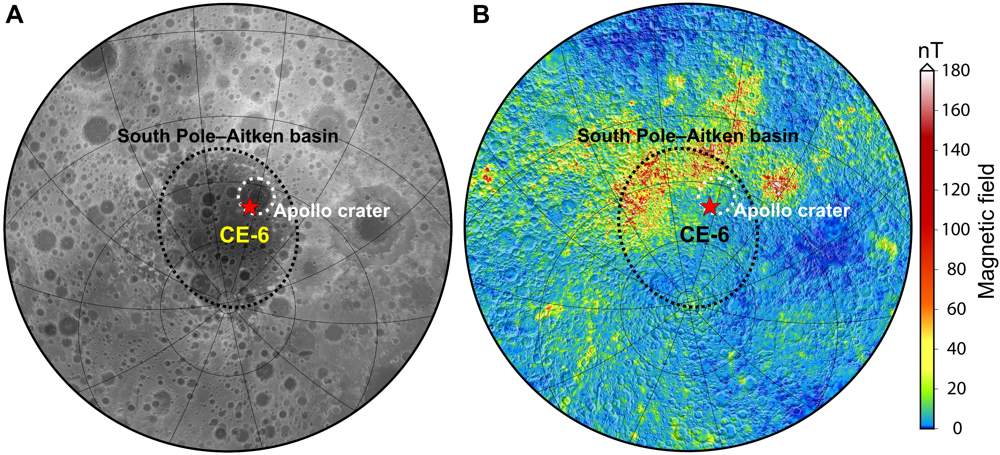
Lunar topography and magnetic anomalies: measurable magnetism remains despite the absence of a global magnetic field. Image: LI Long / Chinese Academy of Sciences.
Structure creates a possible recorder
Electron holography revealed a stable magnetic vortex in some of the larger nanoparticles. Their stable response to an applied magnetic field suggests that this iron could retain magnetic information.
The causal chain is intriguing: an impact produces melt; cooling and the surrounding material preserve an unusual iron phase; that phase supports a stable magnetic structure.
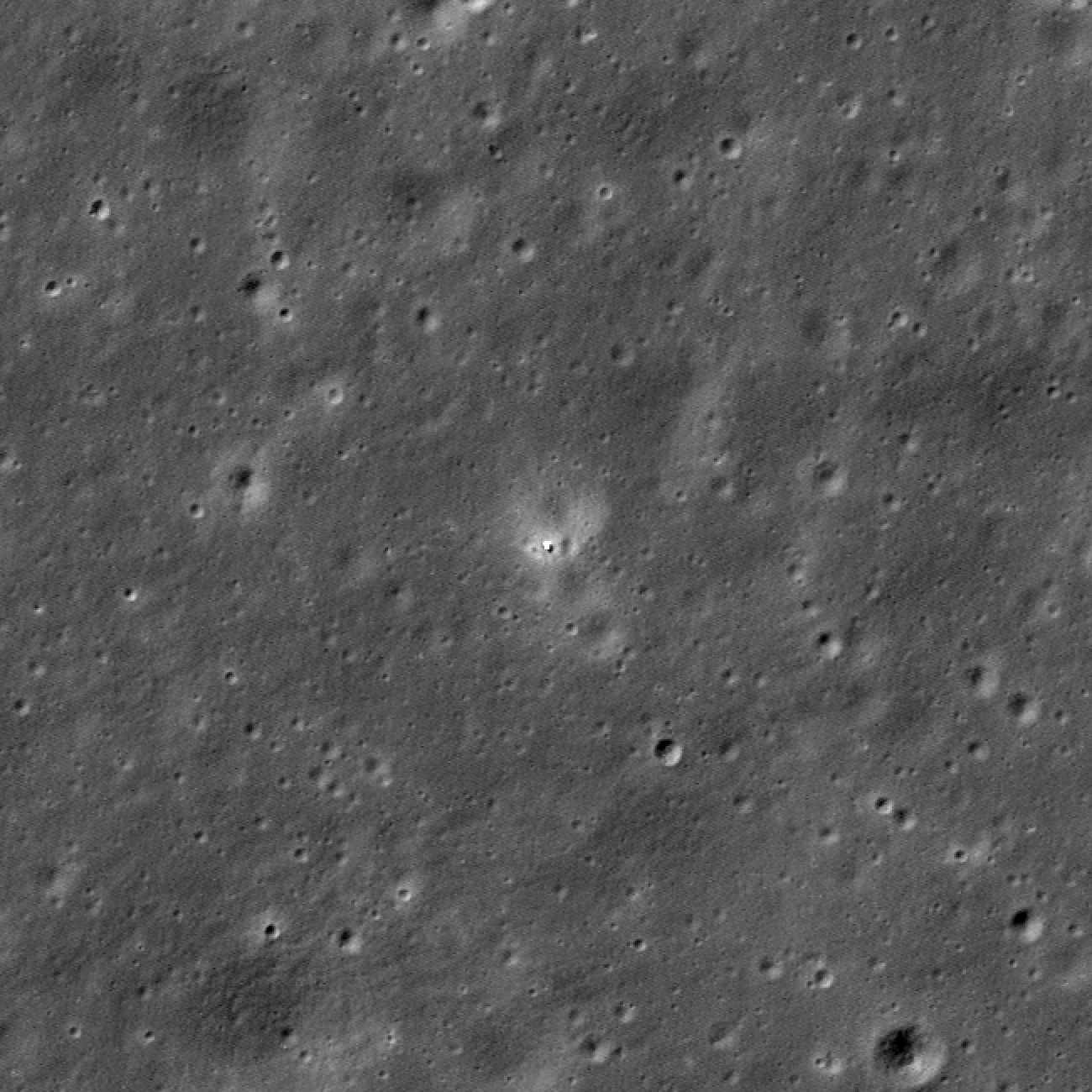
A closer LRO image of the Chang’e-6 lander and the bright terrain disturbed by its engines. Credit: NASA/Goddard/Arizona State University.
A promising recorder is not yet a decoded history
The result does not mean researchers have read a complete account of the Moon’s vanished field from these grains. They have found another candidate material for investigating lunar magnetism.
Further work must clarify what information it preserves and which stages of an impact that information represents.
A process that shattered and melted rock may also have helped create a place for magnetic information to survive.
Sources
Why is Fact Fest free?
We find interesting things and send you one every day. Fact Fest is supported by advertising, which helps us keep finding and sharing more interesting stuff. Never any spam. Cancel any time.