There Can Be Extra Rainbows Inside a Rainbow. What Makes Them?

Real supernumerary rainbows photographed over New Jersey in 2018; featured again by NASA APOD on October 4, 2026. © John Entwistle. NASA publication does not make this photo public domain.
Sometimes a rainbow has narrow extra bands tucked just inside its violet edge.
They are called supernumerary rainbows. Once you notice them, an ordinary rainbow has a new place to look.
These bands are different from the familiar second rainbow outside the first.
What makes the extra stripes—and why did they help scientists understand what light is?
The stripes come from interference
Light waves can reinforce or partially cancel one another. When waves scattered by a raindrop arrive in step, they produce a brighter fringe. When they arrive out of step, the light is reduced.
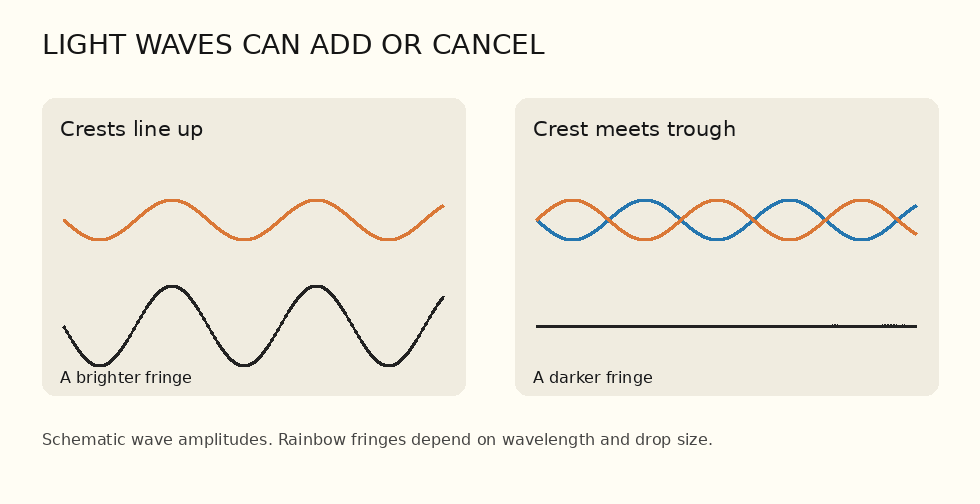
Schematic wave interference: aligned waves reinforce, opposite phases cancel. Diagram: Fact Fest. Actual rainbow fringes depend on wavelength and drop size.
Think of overlapping ripples on water. At some places their crests add; at others, a crest meets a trough. Light has its own version of that behavior.
Why the sky does not always show them
Supernumerary bands show especially well when the droplets are small and similar in size. A wide mixture of sizes produces overlapping patterns that can blur the delicate fringes.
Look just inside the primary bow, particularly near its top. The extra bands can be subtle.

A real rainbow panorama showing a secondary bow outside and faint supernumerary bands inside the primary. © Bernd Thinius / Inastars Observatory Potsdam; NASA APOD, August 7, 2010.
The second bow has another explanation
A secondary rainbow lies outside the primary and has reversed colors. It comes from light making an additional internal reflection in the droplets.
Supernumerary bands require wave interference to explain them. Their existence helped support the wave description of light.
A rain shower can put a physics experiment in the sky. The apparatus is already there; you only have to notice the faint stripes.
Sources
Why is Fact Fest free?
We find interesting things and send you one every day. Fact Fest is supported by advertising, which helps us keep finding and sharing more interesting stuff. Never any spam. Cancel any time.