Did Dinosaurs Find More Than One Way to Fly?
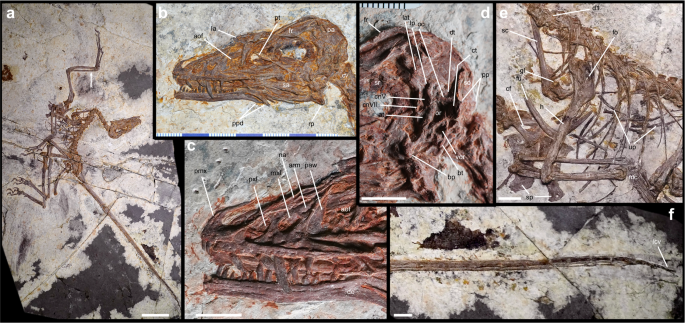
The actual Norellraptor barsboldi fossil and anatomical close-ups. Credit: Wang et al., Nature Communications (2026), Figure 1, CC BY.
A newly described dinosaur fossil preserves a nearly complete skeleton and traces of feathers.
That alone is wonderful. But Norellraptor barsboldi also helps researchers ask a bigger question.
Did birds and some of their close dinosaur relatives inherit one finished flight system? Or did different branches assemble their own?
The interesting clue is not just which features they shared. It is the order in which those features appeared.
Similar equipment, a different sequence
The study supports independent assembly of flight-related adaptations in microraptorines and the bird lineage. Some anatomical changes appeared in both groups, but researchers reconstructed different sequences of acquisition.
That weakens the idea that both followed one shared developmental pattern toward flight.
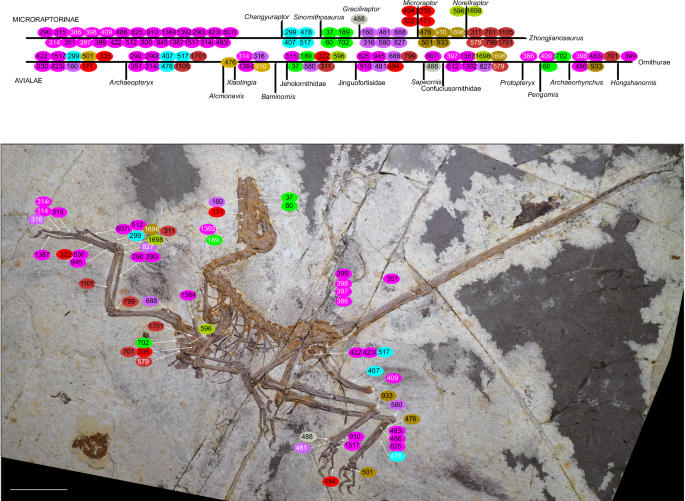
The researchers’ comparison of the order in which traits appeared in microraptorines and birds. Credit: Wang et al., Nature Communications (2026), Figure 5, CC BY.
A fossil with more than a silhouette
The 57-centimetre skeleton from northeastern China preserves parts of the plumage. Researchers also examined thin sections of an arm bone to investigate growth.
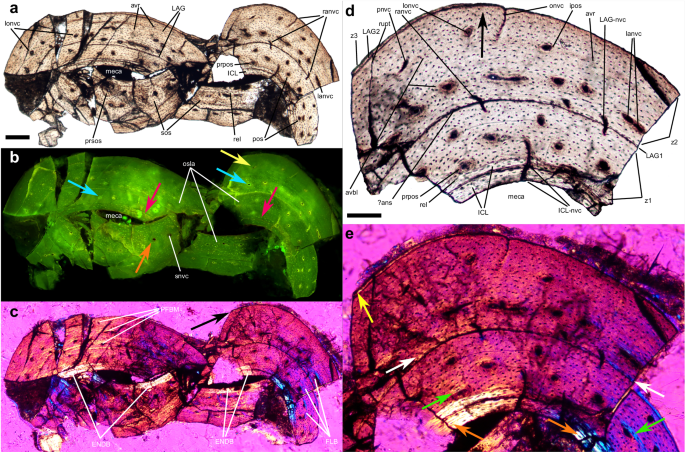
Microscope views of the fossil’s arm bone reveal growth history. Credit: Wang et al., Nature Communications (2026), Figure 3, CC BY.
Bone anatomy, feathers and growth evidence offer different clues. Together they help place the animal within an evolutionary history, rather than simply labeling anything with feathers a flier.
The limit matters
The exact dimensions and form of the plumage are difficult to determine from its preservation. This fossil is not a flight demonstration, and the study does not settle every question about powered flight versus gliding.
It adds evidence that related animals could arrive at aerial adaptations by different routes.
The history of flight may look more like branching experiments than a single staircase leading to birds.
Sources
Why is Fact Fest free?
We find interesting things and send you one every day. Fact Fest is supported by advertising, which helps us keep finding and sharing more interesting stuff. Never any spam. Cancel any time.